How to Upload an Image in Esxi 5.0 to Install Guest Os
VMware Tools is a software add-on inside the guest Operating System running in a Virtual Motorcar on a VMware based virtualization platform (vSphere, Workstation, Fusion). Information technology is not mandatory to use information technology in order to run a VM, but it does provide notable improvements and extra features. For this reason, it is highly recommended by VMware to install it, usually after a fresh OS install for a master image.
VMware Tools is the aforementioned for VMware ESXi, VMware Workstation, VMware Thespian, and VMware Fusion. Merely the features required differ. Note that other virtualization platforms have a similar concept: for example, Microsoft Hyper-V has the Integration Services, Nutanix AHV has the NGT (Nutanix Guest Tools).
Why Install VMware Tools?
As mentioned, VMware Tools is very useful because it provides a lot of improvements and features:
- New device drivers, too paravirtualized: VMXNet NIC drivers, Paravirtual SCSI driver, Audio driver
- Improved mouse (too in the HTML5 console) and video (with the SVGA driver)
- Memory management improvement: adding the memctl driver used past memory ballooning.
- Virtual automobile monitoring: including new graph, VM heatbeat (used for example for vSphere HA VM), detailed invitee information (including IP addresses, invitee Os hostname, …)
- Guest time synchronization
- Invitee Introspection useful for antirust and/or NSX integration
- Support for quiescing a file organisation
- Capability to run custom scripts
- Customize guest operating systems as a role of the vCenter Server and other VMware products
- Ability to gracefully shut down or restart the VM
- On Workstation, Player or Fusion there are other features similar the possibility to share files with the host Os.
Is in that location whatever reason not to install VMware Tools?
Near paravirtualized device drivers are now included in Linux Kernels or even in Windows mainline driver updates. But VMware Tools is more but the driver role.
Some state that it can reduce the security of your guest OS, but this is not truthful. Others prefer not to install information technology as it volition disable some related features, for instance not enabling memory ballooning into the VM. However, there are improve options to disable specific features similar this.
Note that there are as well buggy (deprecated) versions of VMware Tools, like 10.3.0, due to a VMXNET3 driver related issue (for more than information, run across VMware KB 57796). Those versions should never be installed!
Installing VMware Tools should be function of the process of creating a new VM and upgrading them should be role of the VMs' lifecycles.
This article will provide more details on how to perform those steps. For more data refer to the official documentation.
VMware Tools Formats
The VM Tools can exist sources through 3 different channels to adapt the vast majority of environments.
- Congenital-in: While VMware Tools is a common component across various VMware products, it is commonly included with those referred to equally the "built-in" format.
- Asynchronous: Historically, it has been included in VMware ESXi, VMware Workstation, VMware Thespian, and VMware Fusion. Nevertheless, from September 3rd, 2015, it is also possible to download it independently. This is the "downloadable" (or asynchronous) format.
- VM Tools for Linux:
- Open VM Tools (OVT): It's the Open Source implementation of VMware Tools for Linux guest OSes or other Unix OSes and VMware's recommended implementation. Annotation that the OVT packages are bundled with most recent Linux distributions (RHEL 7 and above for Reddish Chapeau), making it easy to manage its lifecycle like all the other Linux packages. For more information refer to the original documentation .
- Operating Organisation Specific Packages (OSP): Those are typically available for older Linux releases (RHEL vi and under for Ruddy Hat). OSPs are signed and hosted past VMware and can be installed in the Os with your package director for example (deb, rpm…).
From now on, in the vast bulk of cases and unless there are special environmental considerations, customers should use built-in VMware tools (be information technology the Windows version embedded in ESXi or Linux OVT).
VMware Tools versions
As mentioned, each VMware virtualization platform version comes with its own VMware Tools built-in version. One time the hypervisor has been upgraded, the VMware tools can, in plough, exist updated.
Similar every VMware product, VM tools have a version number and a build number for each iteration. Which are associated (bundled) with specific vSphere, Fusion and Workstation versions.
At that place is an official document from VMware to assist keep this matching.
For case, for vSphere 6.five and 6.7 those are the master built-in versions:
| VMware vSphere version | VMware Tools version | VMware Tools build |
| vi.v | x.ane.0 | 10252 |
| 6.5U1 | 10.1.7 | 10279 |
| 6.5U2 | 10.2.i | 10305 |
| 6.5U3 | ten.3.10 | 10346 |
| 6.7 | 10.2.0 | 10304 |
| six.7U1 | 10.iii.ii | 10338 |
| 6.7U2 | 10.3.10 | 10341 |
| 6.7U3 | 10.3.10 | 10346 |
Is it possible to verify your VMware Tools version?
- From within the Windows guest
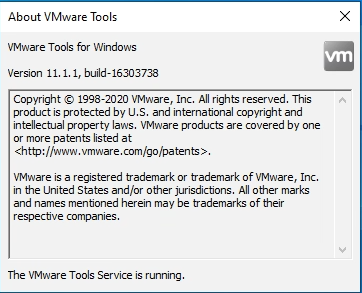
From inside a Windows guest Os, you can brandish the version and build of the installed package using the command line:

Or but open the VMware Tools icon in the organisation tray (this does not employ if you lot have a Windows Server Core installation):
- From inside the Linux guest
For Linux distributions, y'all can either check the bundle information or query the "vmware-toolbox-cmd" control.
VMwareToolboxCmd.exe -v
- vSphere / vCenter
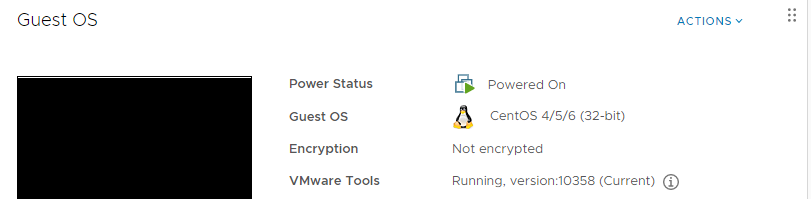
In the vSphere spider web client, display the details of a running VM to obtain the version. Note that the VM and the tools within of it must be running for the VMware tools to be effectively queried by ESXi. Yous also get the status of the VMware tools which volition tell you if the best version is running.
- PowerCLI
If you lot use PowerCLI for your reports, automation, or daily admin life, y'all can also go the VM Tools version and status of one or several virtual machines. You lot will find these details in the post-obit backdrop of a VM object (one time once more, the VM must exist running and not crashed):
Version : $VM.Invitee . ExtensionData . ToolsVersion
Condition : $VM.Guest . ExtensionData . ToolsVersion
How to Install VMware Tools
Which version and format should I use?
Offset of all, which version should I choose? Unremarkably, for all supported guest OSes (see VMware KB 2015161), the latest version is best, considering that information technology is also backward (and forrad) compatible with unlike versions of hypervisor. The suggested rule is to keep them updated at least with the build-in version. Yet, do brand sure that your VMware Tools version is at least "newer" than the hardware level (compatibility) of the virtual machine every bit they contain the drivers for the new virtual hardware.
Note that there are also some "frozen" versions of VMware Tools for supporting legacy OSes. In that case, of course, the dominion is to use the latest frozen version.
Then, which format should I utilise? Usually, for Windows Bone you will use the congenital-in format and the OVT format for contempo Linux distribution.
Refer to the VMware Compatibility Guide for more than detailed information. Specify the Guest Os category, version and the VMware product.
For example, see the recommendations for Debian 10 running on ESXi 7.0:
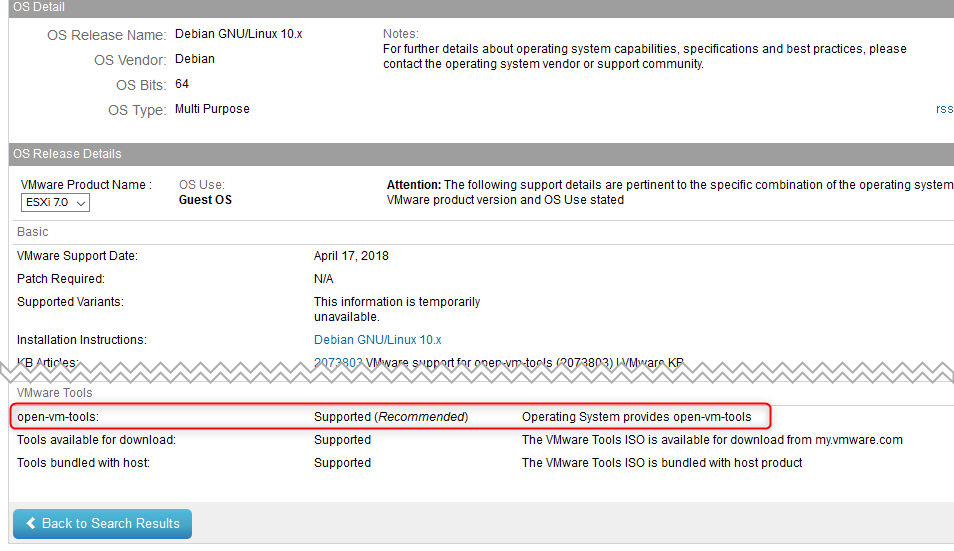
On ESXi the OVT is supported and the OSP is not.
For Windows Server 2022 both the born and downloadable formats are supported. Annotation that the guest OS compatibility guide volition provide a lot of other useful data, including the back up level, the recommended driver types, and specific notes for the installation or configuration of the guest Bone.
Installing VMware Tools
At present we will talk over how to install VMware Tools on ESXi in 4 different cases:
- Built-in VMware Tools for Windows Bone
- Downloadable VMware Tools Windows Bone
- Unattended install Windows Os
- OVT for Linux Bone
I will not consider OSP equally information technology is specific to legacy Linux distributions which are bound to disappear and would require its own blog postal service. In some cases, it may likewise require the programmer library and the compiler.
- Congenital-in VMware Tools for Windows OS
This is the easy fashion and for VMware Workstation, Thespian, Fusion tin likewise be automated during the Bone installation.
For VMware vSphere, using the vSphere (HTML5) client, right-click on the VM and select Guest Os > Install Tools.
This will non install VMware Tools as the hypervisor is not "guest enlightened" yet, it volition simply mountain a guest Os-specific ISO file to the VM virtual CD-ROM. To employ this type of installation, having a virtual CD-ROM in your VM is mandatory!
Some ISOs are included and depending on the guest OS one of them will exist used:
- windows.iso for all Windows Bone NT half dozen.0 (Vista or Windows Server 2008) or later on.
- winPreVista.iso for Windows guest OSes before than Windows Vista.
- linux.iso for Linux invitee OSes glibc 2.5 or later.
Note that since the release of VMware Tools ten.1 (on 2015) just a subset of guest OSes is included in the congenital-in version, removing some legacy or uncommon OSes. In this case, the only solution is to use the downloadable format. Information technology's too possible to add together new ISO in the congenital-in version, simply this case will be considered later.
At present that the ISO is mounted in your VM, you tin proceed with the existent VMware Tools installation steps. For Windows, y'all can employ the autorun or double-click the setup.exe file and the installation will outset.
At that place are 3 different installation options:
- Typical: suitable for nigh ESXi apply cases and should exist selected as the default.
- Complete: Suitable in highly heterogeneous environments.
- Custom: Use it to install specific components such equally Guest Introspection Sparse Agent driver, App Defense force or vShield. You may also want to remove some features in non-standard environments.
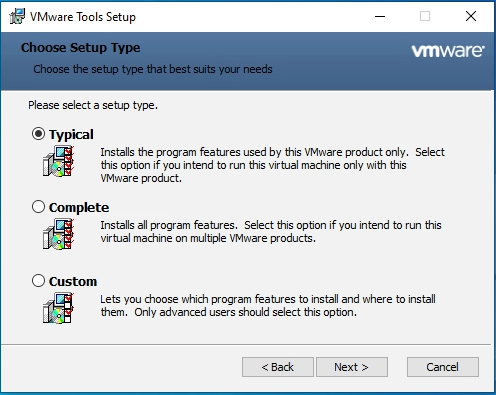
Essentially, the typical installation does not include specific options such as:
- Guest introspection and VMware AppDefense which may be needed with some antivirus for VMware vSphere or in some cases in an NSX deployment.
- Shared folders which are not supported on ESXi, so it should simply be installed in VMs running on VMware Workstation, Role player or Fusion.
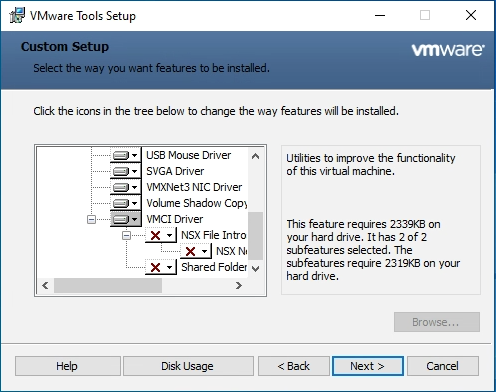
All other drivers and features should be installed. For that reason, the typical installation is usually the best pick in ESXi environments.
Later on the installation, a Windows restart is needed fifty-fifty though well-nigh of the VMware Tools features are already running. Note that during the installation you may experience minor issues in your VM due to the commuter installation and virtual hardware reconfiguration (for case you volition see a temporary blank screen in your panel).
Of course, the interactive installation is one possible way to add VMware Tools, simply there is also a non-interactive fashion (unattended) that volition exist described after, which is useful for scripting or for Windows Server Core.
On Windows Os, VMware Tools installation will also install (if non present) the proper Microsoft Visual C++ library version and a certain service pack level of the OS may exist needed to install them. The required Visual C++ version is specified in each VMware Tools release notes.
- Downloadable VMware Tools Windows OS
The first question is how practise I download VMware tools? You can download it from the specific VMware product page choosing the Commuter & Tools tab:
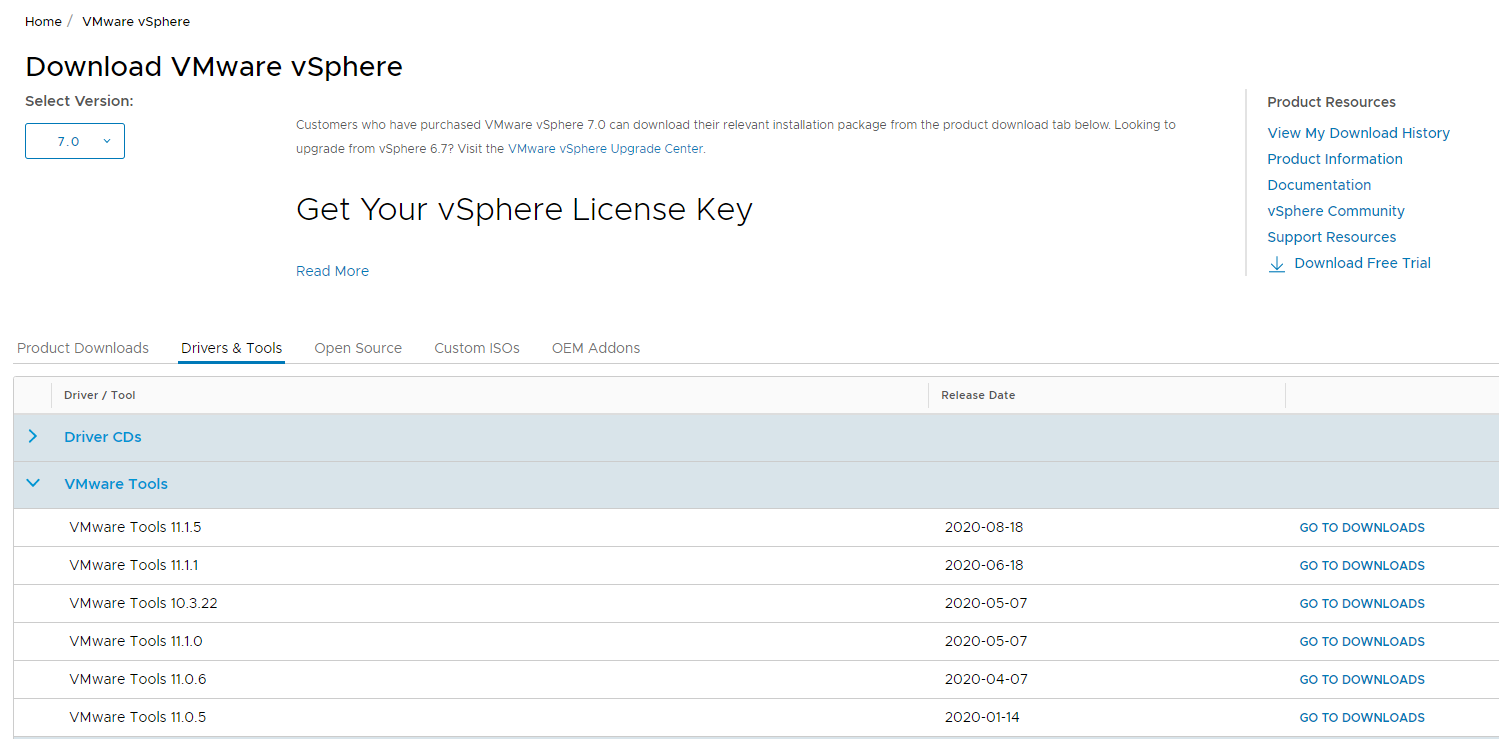
For each version you have different download options:
- Binary packages for Windows
- MSI packages for Windows
- Binary packages for Mac OS X
- Offline VIB package for ESXi
- For older versions, you may besides have specific Linux binary packages
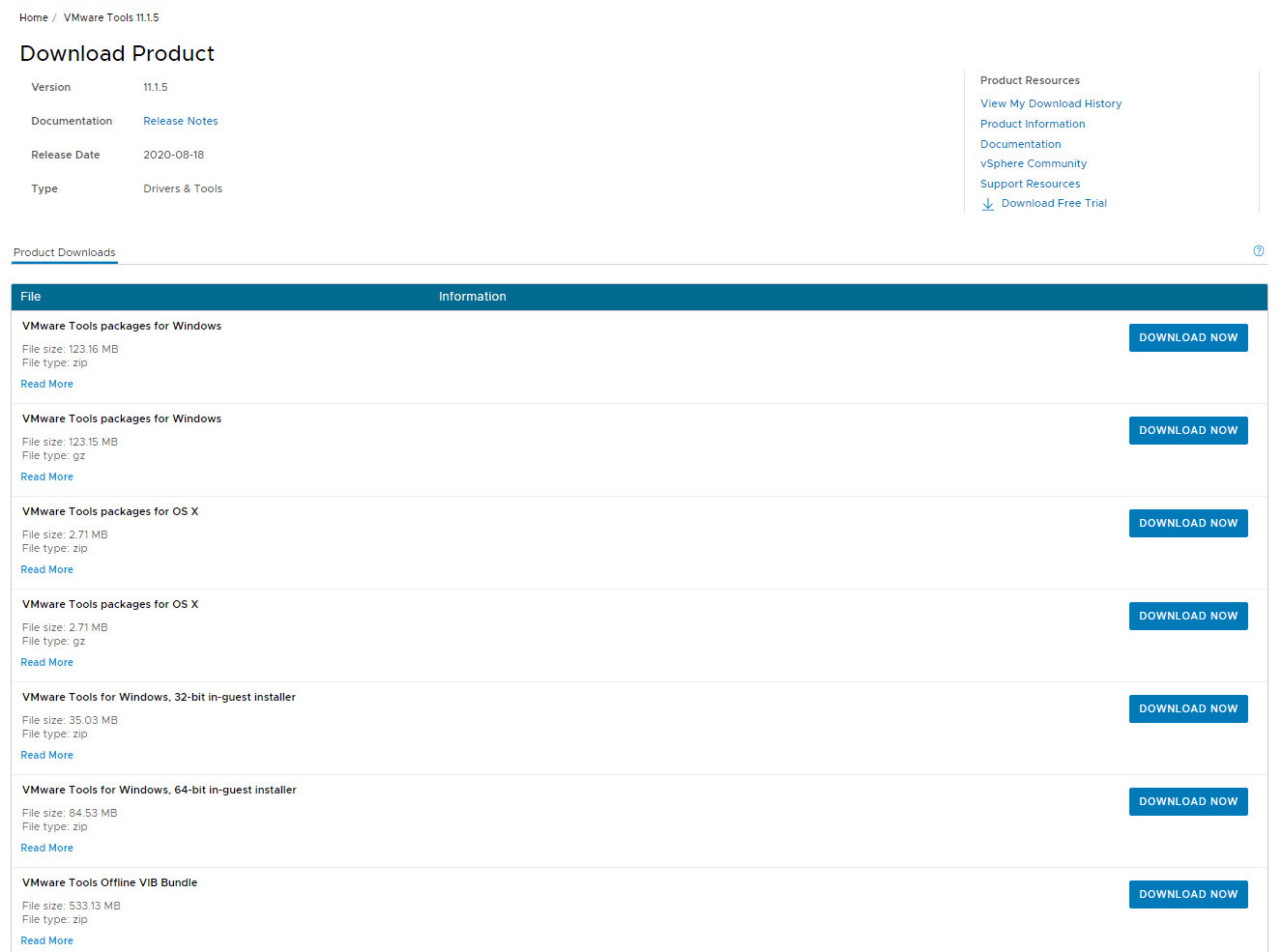
To access the different VMware Tools versions, you lot tin also employ this straight download link.
Let's consider the Windows packages. The binary format is a ZIP or tar.gz file that contains the ISO file. One time y'all take downloaded the ISO you will need to mountain it on the VM. You can do so interactively through the virtual console or upload it to a datastore. Once the ISO is mounted, refer to the previous chapter for the installation steps.
- Unattended install Windows Bone
More interesting is how to perform a non-interactive installation on Windows using either the exe or msi file:
- Apply setup.exe options to perform a silent installation (this also works with the built-in format discussed before)
- Utilize the MSI packet to distribute and automate its installation with traditional deployment tools similar Agile Directory GPO, or Microsoft System Centre.
Let's meet how to perform a silent installation using the proper setup.exe options. Below is an example of a typical installation with logging enabled.
setup.exe /due south /v"/qn /50*v ""%TEMP%\vmmsi.log"""
Note that the arroyo besides works for VMware Tools update/upgrade.
Of course, you can besides specify which features should be installed. To exclude some components, employ the ADDLOCAL and REMOVE options. The example below installs all components but the shared folder feature:
setup.exe /S /v "/qn REBOOT=R ADDLOCAL=ALL REMOVE=Hgfs"
- OVT for Linux OS
This operation depends on the Linux distribution type because unlike bundle managers are used in unlike types of distributions. Notation that most main distributions include the OVT so y'all may not need to install it. Updating the package would be recommended, even so.
For Debian/Ubuntu:
sudo apt-get install open-vm-tools
For RedHat/CentOS (using yum):
sudo yum install open-vm-tools
Note that an optional package named "open up-vm-tools-desktop" can be installed to improve interaction with the VM, resize the display …
Unlike the Windows version, installing OVT (likewise OSP) on Linux does not crave whatsoever reboot. Although consider that new device drivers may be added and the boot ramdisk image may change. A planned reboot would guarantee that the installation is right and the Linux Bone still boots properly.
How to update the born version on the ESXi host
Equally mentioned earlier, the built-in version depends on the host's version. However, is information technology possible to use the downloadable version to update the built-in version? I inquire this because the installation (and also the update/upgrade) of VMware Tools is very easy in this case and can be performed from the virtualization platform.
In the case of vSphere there are 2 unlike ways to update the congenital-in VMware Tools with a desired downloadable version:
- Using the offload VIB (vSphere Installation Bundle) bundle
The VIB package is a very interesting and like shooting fish in a barrel way to update your ESXi built-in version. You tin install a VIB package on ESXi using the esxcli (see KB 2008939) or VUM (at present called LifeCycle Manager). Here is a consummate guide on how to install a VIB packet on ESXi.
- By manually updating the ISO file
Usually, all the bundled Tools ISO image files are located in the ESXi filesystem in the /locker/packages/ directory. However, the partition where /locker resides is limited and may not have plenty free space to store all VMware Tools packages. Also, new ESXi patches or updates that include a new tools-light VIB package may overwrite or change the content of this directory.
For those reasons, you tin can specify a new repository using the UserVars.ProductLockerLocation variable.
You can download the VMware Tools packages from VMware site and then extract and copy the vmtools and floppies sub-directories to new productLocker destination.
One interesting arroyo is to configure a centralized repository for several ESXi hosts, as described in this guide.
How to Update an Installed Version in a Guest Bone
- Linux OVT
In order to keep the OVT updated, keeping your Linux distribution updated will do just that. It is obviously as well possible to update the tools using the OS's packet manager.
- Windows Built-in
In this instance, the procedure may change a little between the different VMware product, the virtualization layer detects whatsoever outdated VMware Tools versions (compared with the congenital-in version, of grade).
For instance, in a vSphere environment, yous will observe that the condition of the VMware Tools changes from "Current" to "Upgrade available". Note that you can go this information in PowerCLI every bit described previously.
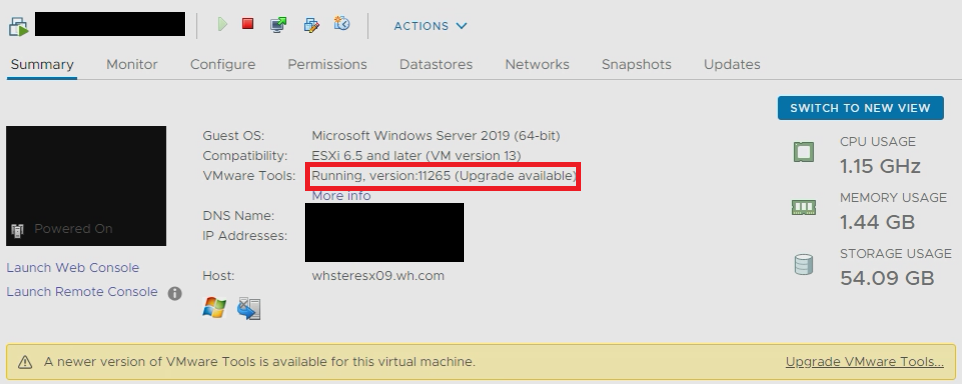
To update/upgrade the VMware Tools, click on "Upgrade VMware Tools…", or using the vSphere (HTML5) client, right-click on the VM and select Guest Bone > Upgrade VMware Tools.
A popup window will offer the choice of upgrade:
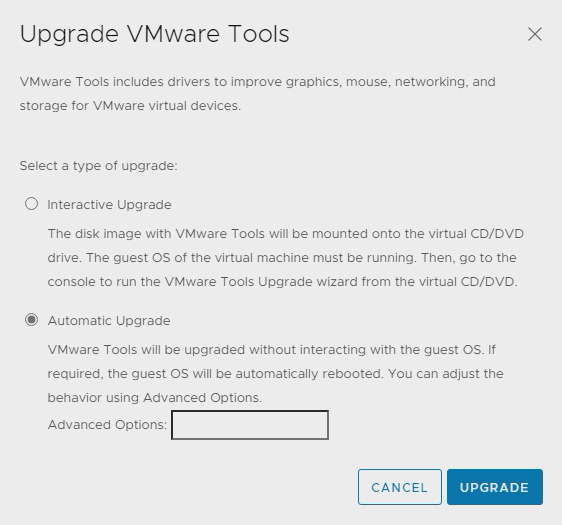
Yous tin choose from the 2 dissimilar means to update/upgrade the VMware Tools in the invitee OS:
- Interactive upgrade: Similar to a fresh installation (equally described earlier) and requires guest Bone access with authoritative credential to perform the operation.
- Automatic upgrade (default): Unattended operation which updates your VMware Tools and does non require any guest OS credential (remember that VMware Tools runs as a local service with high privileges).
Automatic VMware Tools upgrade is supported simply for virtual machines with a Windows guest operating organization.
- Other considerations
Is an Bone reboot needed to complete an update/upgrade?
Starting with VMware Tools ix.ten (with vSphere five.1) no reboots will be required for subsequent VMware Tools upgrades on Windows OS. Nevertheless note that at that place are many cases where a reboot will happen, for example on version x.3.x if Visual C++ libraries must be updated (see this post). Be aware that the reboot volition be automatically and silently performed if you accept chosen the automatic upgrade selection.
On Linux, a reboot is not needed either for the installation or for the update/upgrade.
However, I suggest to ever consider a VMware Tools update/upgrade every bit a modify in your organisation and plan this functioning outside product hours (at least for production systems). Besides, commuter upgrades may cause a short freeze of your VM. For those reasons I suggest planning a reboot after the VMware Tools update/upgrade and use this window to finalize another invitee OSs update and then reboot the VM.
What nearly update/upgrade the VMware Tools if you are using the downloadable version?
In the case of a vSphere environment, I suggest to get-go update the built-in version using the offline VIB package (or use the centralized repository) as described before. This will take y'all to the previous situation on how to update VMware Tools using the built-in version.
Silent or batched updates could exist performed as described in the installation process as well equally with PowerCLI cmdlet.
For more data on the install/update/upgrade procedure see the VMware Tools documentation or also the VMware KB 2004754 – old but all the same valuable.
At that place is likewise a great mail about how to go along the VMware Tools updated which describes a different style for VMware vSphere by embedding the VMware Tools check in the VM property settings.
How to bank check VMware Tools version for more than VMs
In the VM lists of the vSphere client, add the cavalcade to display the Tools versions and status. VMware Tools Version Status is the field that reports the build number of the VMware Tools installed in your guest OSes:
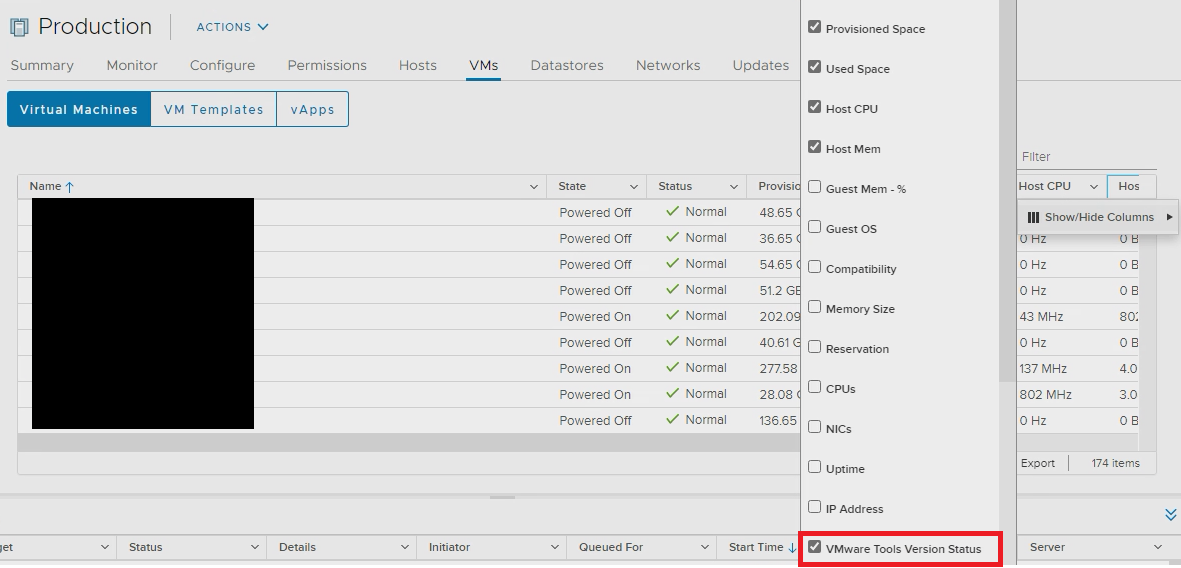
Note that yous tin can besides consign the unabridged tabular array in different formats, including the CSV format (that is the easiest mode to import in a spreadsheet). As suggested previously it is also possible to get this information in PowerCLI.
How to update VMware Tools on several VMs
You can besides beginning a massive VMware Tools update on a bunch of VMs and on specific timing. VUM (at present chosen LifeCycle Managing director) can not simply perform ESXi patching but also automatically manage the VMware Tools update for a select list of VMs (for example all VMs in a VM folder).
In that location are unlike articles that describe this method, but it is the same process as the host patching. Big updates tin also be performed with PowerCLI, similar in the example of upgrading VMware Tools in all VMs while preventing the automatic reboot should at that place be i:
Get – VM * | Update – Tools -NoReboot
Why Can't I Install/Update/Upgrade VMware Tools?
There can be several cases when the VMware Tools installation or update/upgrade volition neglect or will not complete successfully.
First, allow'southward starting time with some general recommendations:
- Be sure not to have a pending reboot in the guest Bone: this may forbid a correct installation or update/upgrade for each software package, including of course VMware Tools
- Be certain to have plenty free disk space in the invitee OS: usually, during the installation/update/upgrade this cheque is performed automatically.
- Be certain to follow the right order during an update/upgrade: for all VMware products, there is the VMware Product Interoperability Matrices that can help you in a full-stack update.
- Be sure that no ISO is continued to your VM and, if present, umount information technology (on Linux/Unix) or squirt if (on Windows) before starting the VMware Tools install or update. This is very important in the born version.
- Antivirus may block VMware installation or update.
If y'all are using the ProductLockerLocation variable as described before, attempts to upgrade or install without setting the variable properly will fail with a missing ISO error. For more information, see the VMware KB 2129825.
In case the VMware Tools installation remains pending you lot can attempt to stop the operation by selecting, in the vSphere Client, Invitee > Stop VMware Tools Install. For more than data, read this post.
Sometimes you demand to reinstall VMware Tools subsequently deleting information technology because the update/upgrade does not work at all.
To perform a full removal, for a Windows OS, just employ the control console and and so verify that the C:\Program Files\VMware\VMware Tools and C:\ProgramData\VMware\VMware Tools folders are empty. If not delete them and reboot the virtual machine. After that try to re-install the new version.
If you face MSI missing error, you can run the post-obit command to make clean the Windows registry:
setup.exe /C
Conclusion
VMware Tools is often regarded as an optional component past a number of administrators who are not well versed in virtualization and don't understand the purpose that well. Still, ensuring that all virtual machines are equipped with it is crucial to ensure a stable and high-performing virtual environment. It not only improves the user feel when connecting through the virtual panel and facilitates reporting, but also enables of import memory reclamation mechanisms that could foreclose VM crashes in instance of memory contention on a host, or ensure that all the right drivers are in use.
Source: https://www.altaro.com/vmware/install-vmware-tools-guide/

Post a Comment for "How to Upload an Image in Esxi 5.0 to Install Guest Os"