Metropolitan Museum of Art Role of Arts in Society
| | |
| Established | 1872 |
|---|---|
| Location | 5th Avenue and 82nd Street, Manhattan, New York |
| Visitor figures | 4 million/yr |
| Director | Philippe de Montebello |
| Website | http://world wide web.metmuseum.org/ world wide web.metmuseum.org |
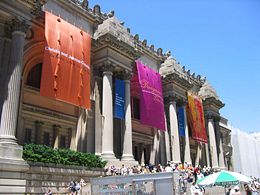
The Metropolitan Museum of Art, founded in 1870 and opened in 1872, is an fine art museum located on the eastern edge of Central Park, forth what is known as Museum Mile in New York City, USA. Information technology has a permanent collection containing more than two million works of fine art, divided into nineteen curatorial departments.[one] The master edifice, often referred to simply as "the Met," is i of the world'south largest and the finest art galleries, and has a much smaller second location in Upper Manhattan, at "The Cloisters," which features medieval art.
The Museum'southward drove ranges from ancient to gimmicky with origins around the earth. The Museum has been making remarkable efforts in preserving cultural artifacts its high preservation standards. The Museum strives to operate with the "highest professional, scholarly, and ethical standards in every aspect of the Museum's governance, programs, and operations."[two] As with the case of other notable museums, the Metropolitan Museum of Art works to enhance people's respect, friendship, and understanding in various global community.
Contents
- 1 Overview
- 2 Mission
- 3 History
- 4 American decorative arts
- five American paintings and sculpture
- six Ancient About Eastern art
- 7 Artillery and armor
- 8 Arts of Africa, Oceania, and the Americas
- 9 Asian art
- x The Costume Institute
- xi Drawings and prints
- 12 Egyptian art
- 13 European paintings
- xiv European sculpture and decorative arts
- fifteen Greek and Roman art
- sixteen Islamic art
- 17 Robert Lehman Collection
- 18 Libraries
- 19 Medieval art
- 19.1 Chief building
- nineteen.2 The Cloisters
- twenty Modern art
- 21 Musical instruments
- 22 Photographs
- 23 Special exhibitions
- 24 Acquisitions and deaccessioning
- 25 In popular culture
- 26 Gallery of paintings
- 27 See also
- 28 Notes
- 29 References
- 30 External links
- 31 Credits
Today the Met is served by more than ane,800 professional staff and 900 volunteers, measures almost a quarter mile long and occupies more than two 1000000 square anxiety; more than than twenty times the size of the original 1880 edifice.[3]
Overview
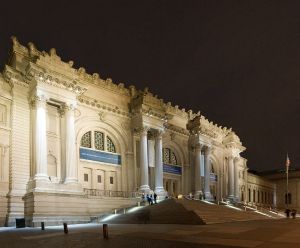
The facade of the Metropolitan Museum is one of the chief features of New York City's "Museum Mile".
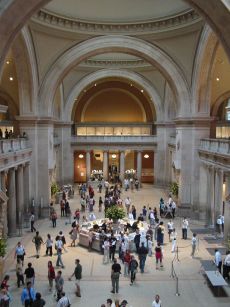
The Met'due south permanent collection is cared for and exhibited by xix split up departments, each with a specialized staff of curators, restorers, and scholars.[1]
Represented in the permanent collection are works of fine art from classical antiquity and Ancient Egypt, paintings and sculptures from almost all the European masters, and an all-encompassing collection of American and modern art. The Met besides maintains extensive holdings of African, Asian, Oceanic, Byzantine and Islamic fine art.[4] The museum is too home to encyclopedic collections of musical instruments, costumes and accessories, and antique weapons and armor from around the earth.[five] A number of notable interiors, ranging from 1st century Rome through modern American design, are permanently installed in the Met's galleries.[six]
In addition to its permanent exhibitions, the Met organizes and hosts large traveling shows throughout the year.[7]
Mission
The Metropolitan Museum of Art holds its mission:
The mission of The Metropolitan Museum of Art is to collect,
preserve, study, exhibit, and stimulate appreciation for and accelerate knowledge of works of art that collectively correspond the broadest spectrum of human being achievement at the highest level of quality, all in the service of the public and in accordance with
the highest professional standards.[eight]
Guided by this mission, the Museum has been striving for achieving the goals of: comprehensive collection development of cultural heritages of the world from artifact to the contemporary; preservation of fine and delicate works of arts with the highest standard of preservation skills, knowledge, and technologies; exhibition of the collections to all people to promote awareness of heritages of humanity; setting the standards for all aspects of museum operations.[9]
History
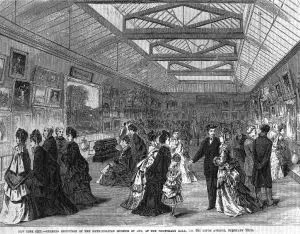
Opening reception in the picture gallery at 681 Fifth Avenue, February twenty, 1872. Wood engraving published in Frank Leslie's Weekly, March 9, 1872.
The Metropolitan Museum of Art outset opened on Feb 20, 1872, housed in a building located at 681 Fifth Avenue in New York City. John Taylor Johnston, a railroad executive whose personal art collection seeded the museum, served as its first President, and the publisher George Palmer Putnam came on board every bit its founding Superintendent. Under their guidance, the Met's holdings, initially consisting of a Roman stone sarcophagus and 174 mostly European paintings, chop-chop outgrew the available space. In 1873, occasioned by the Met's purchase of the Cesnola Collection of Cypriot antiquities, the museum decamped from Fifth Artery and took up residence at the Douglas Mansion on West 14th Street. However, these new accommodations were temporary.
Afterwards negotiations with the metropolis of New York, the Met caused land on the east side of Primal Park, where information technology built its permanent home, a red-brick Gothic Revival rock "mausoleum" designed by American architects Calvert Vaux and Jacob Wrey Mould. The Met has remained in this location ever since, and the original construction is nevertheless part of its current building. A host of additions over the years, including the distinctive Beaux-Arts facade, designed by Richard Morris Hunt and completed in 1926, take connected to expand the museum's physical structure. As of 2007, the Met measures well-nigh a quarter mile long and occupies more 2 million square feet, more than than 20 times the size of the original 1880 building.[x]
American decorative arts
The American Decorative Arts Section includes about 12,000 examples of American decorative art, ranging from the belatedly seventeenth to the early on twentieth century. Though the Met acquired its start major holdings of American decorative arts via a 1909 donation past Margaret Olivia Slocum Sage, wife of the financier Russell Sage, a decorative arts department specifically dedicated to American works was non established until 1934. One of the prizes of the American Decorative Arts department is its extensive drove of American stained glass. This collection, probably the most comprehensive in the world, includes many pieces by Louis Comfort Tiffany. The department is also well-known for its twenty-five period rooms, each of which recreates an entire room, furnishings and all, from a noted menstruum or designer. The department's current holdings too include an extensive silvery collection notable for containing numerous pieces by Paul Revere equally well as works by Tiffany & Co.
American paintings and sculpture
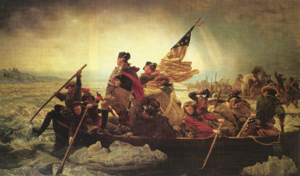
Washington Crossing the Delaware by Emanuel Leutze
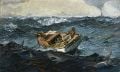
Ever since its founding, the Metropolitan Museum of Fine art has placed a item accent on collecting American art. The starting time piece to enter the Met'south collection was an emblematic sculpture by Hiram Powers titled California, acquired in 1870, which can still be seen in the Met's galleries today. In the following decades, the Met'southward collection of American paintings and sculpture has grown to include more than one thousand paintings, half-dozen hundred sculptures, and two,600 drawings, roofing the entire range of American art from the early Colonial menses through the early on twentieth century. Many of the all-time-known American paintings are held in the Met's collection, including a portrait of George Washington by Gilbert Stuart and Emanuel Leutze's monumental Washington Crossing the Delaware. The collection too includes masterpieces by such notable American painters as Winslow Homer, George Caleb Bingham, John Singer Sargent, James McNeill Whistler, and Thomas Eakins.
Aboriginal Most Eastern art
Beginning in the tardily 1800s, the Met started to acquire ancient art and artifacts from the Nearly Due east. From a few cuneiform tablets and seals, the Met's collection of Near Eastern art has grown to more than 7000 pieces. Representing a history of the region first in the Neolithic Period and encompassing the fall of the Sassanian Empire and the end of Late Artifact, the drove includes works from the Sumerian, Hittite, Sassanian, Assyrian, Babylonian and Elamite cultures (among others), as well as an extensive collection of unique Bronze Age objects. The highlights of the drove include a fix of monumental stone lammasu, or guardian figures, from the Northwest Palace of the Assyrian king Ashurnasirpal 2.
Artillery and armor
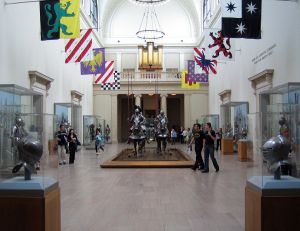
Arms and armor, Middle Ages main hall
The Met'due south Department of Arms and Armor is one of the museum'southward most popular collections. The distinctive "parade" of armored figures on horseback installed in the offset-floor Arms and Armor gallery is ane of the most recognizable images of the museum. The department'due south focus on "outstanding adroitness and ornament," including pieces intended solely for display, means that the collection is strongest in late medieval European pieces and Japanese pieces from the 5th through the nineteenth centuries. Withal, these are not the only cultures represented in Arms and Armor; in fact, the collection spans more geographic regions than near any other department, including weapons and armor from dynastic Arab republic of egypt, aboriginal Hellenic republic, the Roman Empire, the ancient Virtually East, Africa, Oceania, and the Americas, as well as American firearms (particularly Colt firearms) from the nineteenth and twentieth centuries. Among the collection's xv,000 objects are many pieces made for and used by kings and princes, including armor belonging to Henry Two of France and Ferdinand I of Frg.
Arts of Africa, Oceania, and the Americas
Though the Met get-go acquired a group of Peruvian antiquities in 1882, the museum did non begin a concerted endeavor to collect works from Africa, Oceania, and the Americas until 1969, when American businessman and philanthropist Nelson A. Rockefeller donated his more than than 3,000-piece collection to the museum. Today, the Met'southward collection contains more than than 11,000 pieces from sub-Saharan Africa, the Pacific Islands and the Americas and is housed in the twoscore,000-square-foot (4,000 thou²) Rockefeller Wing on the s end of the museum. The collection ranges from 40,000-year-erstwhile Australian Aboriginal rock paintings, to a group of xv-foot high memorial poles carved past the Asmat people of New Republic of guinea, to a priceless drove of formalism and personal objects from the Nigerian Court of Benin. The range of materials represented in the Africa, Oceania, and Americas collection is undoubtedly the widest of any department at the Met, including everything from precious metals to porcupine quills.
Asian art

Hokusai'southward The Great Moving ridge off Kanagawa
The Met's Asian department holds a collection of Asian art that is arguably the most comprehensive in the West. The collection dates back almost to the founding of the museum: many of the philanthropists who made the earliest gifts to the museum included Asian fine art in their collections. Today, an entire wing of the museum is dedicated to the Asian drove, which contains more than 60,000 pieces and spans 4,000 years of Asian art. Every Asian civilization is represented in the Met'due south Asian department, and the pieces on display include every type of decorative art, from painting and printmaking to sculpture and metalworking. The department is well-known for its comprehensive drove of Chinese calligraphy and painting, as well equally for its Nepalese and Tibetan works. However, not simply "art" and ritual objects are represented in the drove; many of the best-known pieces are functional objects. The Asian fly even contains a complete Ming Dynasty garden court, modeled on a courtyard in the Garden of the Master of the Fishing Nets in Suzhou.
The Costume Institute
In 1937, the Museum of Costume Art joined with the Met and became its Costume Institute department. Today, its collection contains more than eighty,000 costumes and accessories. Due to the fragile nature of the items in the collection, the Costume Institute does non maintain a permanent installation. Instead, every year it holds two dissever shows in the Met's galleries using costumes from its drove, with each show centering on a specific designer or theme. In past years, Costume Constitute shows organized around famous designers such as Chanel and Gianni Versace take drawn significant crowds to the Met. The Costume Establish'southward annual Do good Gala, co-chaired by Faddy editor-in-main Anna Wintour, is an extremely pop, if exclusive, event in the fashion world; in 2007, the 700 available tickets started at $half dozen,500 per person.[11]
Drawings and prints
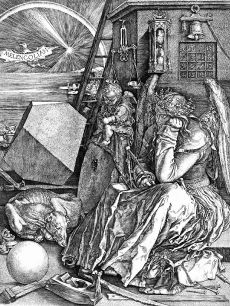
Though other departments comprise significant numbers of drawings and prints, the Drawings and Prints department specifically concentrates on North American pieces and western European works produced after the Middle Ages. Currently, the Drawings and Prints collection contains more than 11,000 drawings, 1.5 million prints, and twelve thousand illustrated books. The collection has been steadily growing always since the first heritance of 670 drawings donated to the museum by Cornelius Vanderbilt in 1880. The great masters of European painting, who produced many more sketches and drawings than bodily paintings, are extensively represented in the Drawing and Prints collection. The section'due south holdings comprise major drawings by Michelangelo, Leonardo da Vinci, and Rembrandt, every bit well every bit prints and etchings by Van Dyck, Dürer, and Degas among many others.
Egyptian art
Though the majority of the Met'south initial holdings of Egyptian art came from private collections, items uncovered during the museum'due south ain archeological excavations, carried out between 1906 and 1941, found almost one-half of the current collection. More than 36,000 separate pieces of Egyptian art from the Paleolithic era through the Roman era establish the Met's Egyptian collection, and almost all of them are on display in the museum'due south massive wing of 40 Egyptian galleries. Among the most valuable pieces in the Met's Egyptian collection are a ready of 24 wooden models, discovered in a tomb in Deir el-Bahri in 1920. These models draw, in unparalleled detail, a veritable cantankerous-department of Egyptian life in the early Middle Kingdom : boats, gardens, and scenes of daily life. However, the pop centerpiece of the Egyptian Art department continues to be the Temple of Dendur. Dismantled by the Egyptian government to save information technology from rise waters acquired past the building of the Aswan High Dam, the large sandstone temple was given to the United States in 1965 and assembled in the Met's Sackler Fly in 1978. Situated in a large room, partially surrounded by a reflecting pool and illuminated past a wall of windows opening onto Central Park, the Temple of Dendur is one of the Met's most enduring attractions.
European paintings

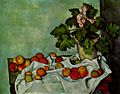
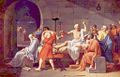
The Met has one of the world's best collections of European paintings. Though the drove numbers but around ii,200 pieces, it contains many of the world's nigh instantly recognizable paintings. The bulk of the Met'southward purchasing has always been in this department, primarily focusing on Old Masters and nineteenth-century European paintings, with an emphasis on French, Italian and Dutch artists. Many great artists are represented in remarkable depth in the Met'south holdings: the museum owns 37 paintings past Monet, 21 oils by Cezanne, and xviii Rembrandts including Aristotle With a Bust of Homer. The Met's 5 paintings past Vermeer represent the largest drove of the artist's work anywhere in the globe. Other highlights of the drove include Van Gogh's Cocky-Portrait with a Harbinger Lid, Pieter Bruegel the Elder's The Harvesters, Georges de La Bout's The Fortune Teller, and Jacques-Louis David's The Expiry of Socrates. In recent decades, the Met has carried out a policy of deaccessioning its "pocket-size" holdings in social club to purchase a smaller number of "world-class" pieces. Though this policy remains controversial, it has gained a number of outstanding (and outstandingly expensive) masterpieces for the European Paintings collection, get-go with Velázquez's Juan de Pareja in 1971. One of The Met's latest purchases is Duccio's Madonna and Child, which cost the museum more 45 million dollars, more than than twice the amount it had paid for whatever previous painting. The painting itself is merely slightly larger than 9 by 6 inches, but has been called "the Met's Mona Lisa."
European sculpture and decorative arts
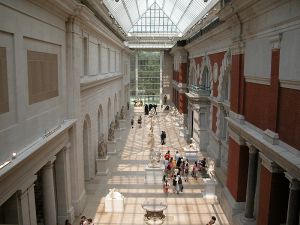
Though European painting may accept its own section, other European decorative arts are well-represented at the Met. In fact, the European Sculpture and Decorative Arts collection is one of the largest departments at the Met, holding in excess of 50,000 separate pieces from the 1400s through the early twentieth century. Though the drove is particularly full-bodied in Renaissance sculpture—much of which can be seen in situ surrounded past gimmicky effects and decoration—it too contains comprehensive holdings of article of furniture, jewelry, glass and ceramic pieces, tapestries, textiles, and timepieces and mathematical instruments. Visitors can enter dozens of completely furnished flow rooms, transplanted in their entirety into the Met's galleries. The collection even includes an unabridged sixteenth-century patio from the Spanish castle of Vélez Blanco, meticulously reconstructed in a 2-story gallery. Sculptural highlights of the sprawling department include Bernini's Bacchanal, a cast of Rodin'south The Burghers of Calais, and several unique pieces by Houdon, including his Bust of Voltaire and his famous portrait of his daughter Sabine.
Greek and Roman art
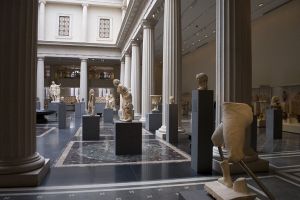
The Met's collection of Greek and Roman art contains more than 35,000[12] works dated through A.D. 312. The Greek and Roman collection dates back to the founding of the museum—in fact, the museum'southward first accessioned object was a Roman sarcophagus, nonetheless currently on display. Though the collection naturally concentrates on items from aboriginal Hellenic republic and the Roman Empire, these historical regions stand for a wide range of cultures and artistic styles, from archetype Greek black-figure and red-figure vases to carved Roman tunic pins. Several highlights of the drove include the Euphronios krater depicting the decease of Sarpedon (whose buying has since been transferred to the Democracy of Italy), the awe-inspiring Amathus sarcophagus, and a magnificently detailed Etruscan chariot known as the "Monteleone chariot." The drove also contains many pieces from far earlier than the Greek or Roman empires—amongst the well-nigh remarkable are a drove of early Cycladic sculptures from the mid-third millennium B.C.Due east., many so abstruse as to seem near modern. The Greek and Roman galleries also contain several large classical wall paintings and reliefs from different periods, including an entire reconstructed chamber from a noble villa in Boscoreale, excavated after its entombment by the eruption of Vesuvius in 79 C.Eastward. In 2007, the Met'due south Greek and Roman galleries were expanded to approximately 60,000 square feet (six,000 m²), allowing the majority of the collection to be on permanent brandish.[13]
Islamic art
The Met'south collection of Islamic art is non confined strictly to religious art, though a significant number of the objects in the Islamic drove were originally created for religious use or every bit decorative elements in mosques. Much of the 12,000 strong collection consists of secular items, including ceramics and textiles, from Islamic cultures ranging from Spain to North Africa to Central Asia. In fact, the Islamic Fine art department's drove of miniature paintings from Iran and Mughal India are a highlight of the drove. Calligraphy both religious and secular is well-represented in the Islamic Fine art department, from the official decrees of Suleiman the Magnificent to a number of Qur'an manuscripts reflecting different periods and styles of calligraphy. As with many other departments at the Met, the Islamic Fine art galleries comprise many interior pieces, including the unabridged reconstructed Nur Al-Din Room from an early eighteenth century firm in Damascus.
Robert Lehman Drove
On the passing of banker Robert Lehman in 1969, his Foundation donated shut to 3,000 works of art to the museum. Housed in the "Robert Lehman Wing," the museum refers to the collection as "one of the nearly boggling private art collections ever assembled in the U.s.a.".[fourteen] To emphasize the personal nature of the Robert Lehman Collection, the Met housed the collection in a special set of galleries which evoked the interior of Lehman'due south richly decorated townhouse; this intentional separation of the Collection every bit a "museum within the museum" met with mixed criticism and approval at the time, though the acquisition of the collection was seen every bit a coup for the Met.[fifteen] Unlike other departments at the Met, the Robert Lehman collection does not concentrate on a specific manner or period of fine art; rather, it reflects Lehman's personal interests. Lehman the collector concentrated heavily on paintings of the Italian Renaissance, particularly the Senese school. Paintings in the drove include masterpieces by Botticelli and Domenico Veneziano, too every bit works past a significant number of Spanish painters, El Greco and Goya amid them. Lehman's collection of drawings by the Old Masters, featuring works past Rembrandt and Dürer, is particularly valuable for its breadth and quality.[16] Princeton University Press has documented the massive drove in a multi-volume book series published equally The Robert Lehman Collection Catalogues.
Libraries
The main library at the Met is the Thomas J. Watson Library, named after its benefactor. The Watson Library primarily collects books related to the history of art, including exhibition catalogues and auction sale publications, and generally attempts to reflect the emphasis of the museum's permanent collection. Several of the museum'southward departments take their own specialized libraries relating to their area of expertise. The Watson Library and the individual departments' libraries also concur substantial examples of early or historically important books which are works of art in their ain right. Among these are books by Dürer and Athanasius Kircher, likewise as editions of the seminal Surrealist mag "VVV" and a copy of "Le Description de l'Egypte," commissioned in 1803 past Napoleon Bonaparte and considered i of the greatest achievements of French publishing.
Several of the departmental libraries are open to members of the public without prior appointment. The Library and Instructor Resource Center, Ruth and Harold Uris Center for Pedagogy, is open to visitors of all ages to study fine art and art history and to larn about the Museum, its exhibitions and permanent drove. The Robert Goldwater Library in the department of the Arts of Africa, Oceania, and the Americas documents the visual arts of sub-Saharan Africa, the Pacific Islands, and Native and Precolumbian America. It is open to adult researchers, including college and graduate students. Most of the other departmental libraries are for museum staff only or are open up to the general public by appointment simply.
Medieval art
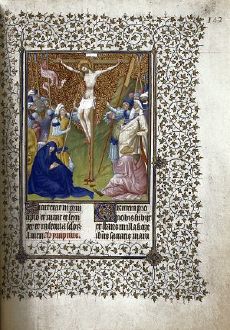
The Limbourg brothers' Belles Heures of Jean of France, Duke of Berry
The Met's collection of medieval art consists of a comprehensive range of Western art from the 4th century through the early sixteenth century, as well as Byzantine and pre-medieval European antiquities not included in the Ancient Greek and Roman drove. Like the Islamic collection, the Medieval collection contains a broad range of ii- and iii-dimensional art, with religious objects heavily represented. In full, the Medieval Art department'southward permanent collection numbers about 11,000 divide objects, divided between the chief museum building on Fifth Artery and The Cloisters.
Main building
The medieval collection in the main Metropolitan building, centered on the offset-floor medieval gallery, contains about six thousand split up objects. While a bang-up bargain of European medieval fine art is on brandish in these galleries, near of the European pieces are concentrated at the Cloisters (see beneath). However, this allows the main galleries to display much of the Met's Byzantine fine art side-by-side with European pieces. The main gallery is host to a wide range of tapestries and church and funerary statuary, while side galleries display smaller works of precious metals and ivory, including reliquary pieces and secular items. The main gallery, with its loftier arched ceiling, as well serves double duty as the almanac site of the Met's elaborately decorated Christmas tree.
The Cloisters

The Cloisters was a chief project of John D. Rockefeller, Jr., who was a major distributor of the Met. Located in Fort Tryon Park and completed in 1938, it is a carve up building defended solely to medieval art. The Cloisters drove was originally that of a separate museum, assembled by George Grey Barnard and acquired in toto by Rockefeller in 1925 as a gift to the Met.[17]
The Cloisters are so named on account of the five medieval French cloisters whose salvaged structures were incorporated into the modern building, and the five yard objects at the Cloisters are strictly limited to medieval European works. The collection exhibited here features many items of outstanding beauty and historical importance; amidst these are the Belles Heures du Duc de Berry illustrated past the Limbourg Brothers in 1409, the Romanesque altar cross known as the "Cloisters Cross" or "Bury Cross," and the vii heroically detailed tapestries depicting the Hunt of the Unicorn.
Modern fine art
With more than than 10,000 artworks, primarily past European and American artists, the modern art collection occupies 60,000 square anxiety (6,000 thousand²), of gallery space and contains many iconic modern works. Cornerstones of the drove include Picasso's portrait of Gertrude Stein, Jasper Johns's White Flag, Jackson Pollock's Fall Rhythm (Number 30), and Max Beckmann'due south triptych Kickoff. Certain artists are represented in remarkable depth, for a museum whose focus is not exclusively on modernistic art: for example, the collection contains forty paintings past Paul Klee, spanning his unabridged career. Due to the Met'south long history, "contemporary" paintings acquired in years past have often migrated to other collections at the museum, particularly to the American and European Paintings departments.
Musical instruments
The Met'southward collection of musical instruments, with almost 5 g examples of musical instruments from all over the world, is virtually unique among major museums. The collection began in 1889 with a donation of several hundred instruments by Lucy Westward. Drexel, but the department'southward electric current focus came through donations over the following years by Mary Elizabeth Adams, wife of John Crosby Brown. Instruments were (and go along to be) included in the collection not only on aesthetic grounds, but as well insofar every bit they embodied technical and social aspects of their cultures of origin. The modernistic Musical Instruments drove is encyclopedic in scope; every continent is represented at virtually every stage of its musical life. Highlights of the department's collection include several Stradivari violins, a collection of Asian instruments made from precious metals, and the oldest surviving piano, a 1720 model by Bartolomeo Cristofori. Many of the instruments in the collection are playable, and the department encourages their apply by belongings concerts and demonstrations past invitee musicians.
Photographs
The Met's collection of photographs, numbering more than 20,000 in total, is centered on five major collections plus additional acquisitions by the museum. Alfred Stieglitz, a famous lensman himself, donated the offset major drove of photographs to the museum, which included a comprehensive survey of Photograph-Secessionist works, a rich set of primary prints by Edward Steichen, and an outstanding collection of Stieglitz'due south photographs from his own studio. The Met supplemented Stieglitz's gift with the 8,500-slice Gilman Paper Company Collection, the Rubel Collection, and the Ford Motor Company Drove, which respectively provided the collection with early French and American photography, early on British photography, and post-WWI American and European photography. The museum too acquired Walker Evans's personal collection of photographs, a particular coup considering the high demand for his works. Though the department gained a permanent gallery in 1997, non all of the section's holdings are on display at whatever given time, due to the sensitive materials represented in the photography collection. However, the Photographs section has produced some of the all-time-received temporary exhibits in the Met's recent past, including a Diane Arbus retrospective and an extensive show devoted to spirit photography.
Special exhibitions
Frank Stella on the Roof features in stainless steel and carbon fiber several works by American artist Frank Stella. This exhibition is set up in The Iris and B. Gerald Cantor Roof Garden, offering views of Fundamental Park and the Manhattan skyline.
Coaxing the Spirits to Dance: Art of the Papuan Gulf presents some 60 sculptures and thirty historical photographs from the Gulf province of Papua New Guinea.
Acquisitions and deaccessioning
During the 1970s, under the directorship of Thomas Hoving, the Met revised its deaccessioning policy. Under the new policy, the Met gear up its sights on acquiring "world-grade" pieces, regularly funding the purchases by selling mid- to loftier-value items from its collection.[18] Though the Met had always sold indistinguishable or small items from its drove to fund the acquisition of new pieces, the Met's new policy was significantly more aggressive and wide-ranging than before, and allowed the deaccessioning of items with higher values which would normally take precluded their sale. The new policy provoked a groovy deal of criticism (in particular, from The New York Times) only had its intended effect.
Many of the items then purchased with funds generated by the more liberal deaccessioning policy are now considered the "stars" of the Met's collection, including Velázquez'due south Juan de Pareja and the Euphronios krater depicting the death of Sarpedon. In the years since the Met began its new deaccessioning policy, other museums have begun to emulate it with aggressive deaccessioning programs of their own.[19] The Met has continued the policy in recent years, selling such valuable pieces as Edward Steichen'due south 1904 photograph The Pond-Moonlight (of which some other copy was already in the Met'south collection) for a record price of $2.9 million.[20]
In popular culture
- The Met was famously used as the setting for much of the Newbery Medal-winning children's book, From the Mixed-Up Files of Mrs. Basil E. Frankweiler, in which the two young protagonists run away from home and secretly stay several nights in the museum. However, Michelangelo'south Affections statue, primal to the volume's plot, is purely fictional and not actually role of the museum's drove.
- The 1948 film Portrait of Jennie was filmed at the both the Museum and The Cloisters.
- Blair Waldorf, Serena van der Woodsen, and a few select classmates at the Constance Billard Schoolhouse for Girls from Gossip Girl Television receiver serial usually eat their dejeuner on the steps of the Met.
- The Met was featured every bit the get-go level in the tactical outset-person shooter Tom Clancy's Rainbow Half dozen: Rogue Spear
- The 1999 version of The Thomas Crown Matter uses the Met every bit a major setting; however, only the exterior scenes were shot at the museum, with the interior scenes filmed on soundstages.
- In 1983, there was a Sesame Street special entitled Don't Eat the Pictures: Sesame Street at the Metropolitan Museum of Art, where the cast goes to visit the museum on-location.
- An episode of Inspector Gadget entitled "Art Heist" had Gadget and Penny and Brain travel to the Met, with Gadget being assigned to protect the artwork. Just M.A.D. Agents steal the masterpieces and plan to supervene upon them with fakes.
- In the 2007 movie I Am Legend, the main character is shown line-fishing in the ruined Egyptian Wing.
- The Met is featured in a season four episode of Project Runway, where 5 remaining designers must create an outfit based on a work of fine art.
Gallery of paintings
-
Bingham
-
Bruegel
-

-
-
-
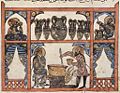
Dioscorides
-
-
-
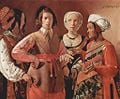
De La Tour
-
-
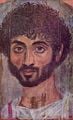
Römisch-Ägyptischer Meister
-
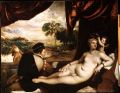
Titian
-
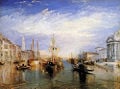
-
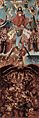
Van Eyck
-

Come across also

- Art museum
Notes
- ↑ 1.0 one.1 The Metropolitan Museum of Art: The Permanent Drove and Special Exhibitions. [1]. accessdate 2008-07-thirteen Cite error: Invalid
<ref>tag; name "metsite_permanentcollection" divers multiple times with unlike content - ↑ Mission Argument, Metropolitan Museum of Art. Retrieved July 14, 2008.
- ↑ The Metropolitan Museum of Fine art. HumanitiesWeb. Retrieved July xiv, 2008.
- ↑ Barbara Fire. Masterpieces of the Metropolitan Museum of Art. New York: Metropolitan Museum of Fine art. 1997.
- ↑ Stuart W. Pyhrr. Arms and Armor: Notable Acquisitions 1991-2002 - The Metropolitan Museum of Art. (New Haven: Yale University Press, 2003), vi.
- ↑ Amelia Peck. Flow Rooms in the Metropolitan Museum of Art. (New York: Metropolitan Museum of Art, 1996), 17, 275.
- ↑ Current Special Exhibitions, The Metropolitan Museum of Art. Retrieved July 14, 2008.
- ↑ Mission Statement, Metropolitan Museum of Art, September 12, 2000. Retrieved July 14, 2008.
- ↑ Ibid.
- ↑ The Metropolitan Museum of Art at HumanitiesWeb. Retrieved July 14, 2008.
- ↑ Virginia Postrel, "Wearing apparel Sense" The Atlantic (May 2007), 133
- ↑ Works of Art: Greek and Roman Fine art. The Metropolitan Museum of Fine art. Retrieved July xiv, 2008.
- ↑ Michael Kimmelman, "Classical Treasures, Bathed in a New Light." 2007-04-20. New York Times [2]. accessdate 2007-07-xiv
- ↑ Metropolitan Museum of Art [http://www.metmuseum.org/Press_Room/full_release.asp?prid={6E3EF378-71B3-4FD1-B7ED-BC5F36E57CD0} THE ROBERT LEHMAN COLLECTION press release, September 1999]. Retrieved July xiv, 2008.
- ↑ Thomas Hoving. Making the Mummies Trip the light fantastic. (New York: Simon and Schuster, 1993).
- ↑ John Russell, Art Review: Feast of Illuminations and Drawings, The New York Times, February 18, 2000. Retrieved July 14, 2008.
- ↑ Metropolitan Museum of Fine art website article on the Cloisters. Retrieved July 14, 2008.
- ↑ Thomas Hoving. Making the Mummies Dance. New York: Simon and Schuster, 1993.
- ↑ James Bone, "Brimful museums put art under the hammer" The Times Online, October 31, 2005. Retrieved July 14, 2008.
- ↑ "Rare photo sets $two.9m sales record" BBC News, February xvi, 2006. Retrieved July 14, 2008.
References
ISBN links support NWE through referral fees
- Burn, Barbara. Masterpieces of the Metropolitan Museum of Art. New York: Metropolitan Museum of Fine art, 1997. ISBN 0300106157
- Hoving, Thomas. Making the Mummies Dance. New York: Simon and Schuster, 1993.
- Peck, Amelia. Menstruum Rooms in the Metropolitan Museum of Art. New York: Metropolitan Museum of Art, 1996. ISBN 0300105223
- Postrel, Virginia. "Dress Sense." The Atlantic May 2007, 133.
- Pyhrr, Stuart W. Arms and Armor: Notable Acquisitions 1991-2002 - The Metropolitan Museum of Art. New Haven: Yale University Press, 2003. ISBN 0300098766
External links
All links retrieved September 19, 2018.
- Metropolitan Museum of Art: official site
- The Metropolitan Museum of Art presents a Timeline of Art History
- The New York Times Metropolitan Museum of Art Topic Page
- Items owned by The Metropolitan Museum of Art
| Popular company attractions in New York Urban center | |
|---|---|
| Times Foursquare (35M) • Cardinal Park (20M) • Metropolitan Museum of Art (iv.5M) • Statue of Liberty (4.24M) • American Museum of Natural History (4M) • Empire State Edifice (4M) • Museum of Modern Art (2.67M) • | |
Credits
New Globe Encyclopedia writers and editors rewrote and completed the Wikipedia article in accordance with New World Encyclopedia standards. This commodity abides by terms of the Creative Commons CC-by-sa 3.0 License (CC-by-sa), which may be used and disseminated with proper attribution. Credit is due under the terms of this license that tin can reference both the New World Encyclopedia contributors and the selfless volunteer contributors of the Wikimedia Foundation. To cite this article click hither for a list of acceptable citing formats.The history of earlier contributions by wikipedians is accessible to researchers here:
- Metropolitan_Museum_of_Art history
The history of this commodity since it was imported to New World Encyclopedia:
- History of "Metropolitan Museum of Art"
Note: Some restrictions may utilize to use of individual images which are separately licensed.
Source: https://www.newworldencyclopedia.org/entry/Metropolitan_Museum_of_Art

Post a Comment for "Metropolitan Museum of Art Role of Arts in Society"